



The story of Lofoten Wool
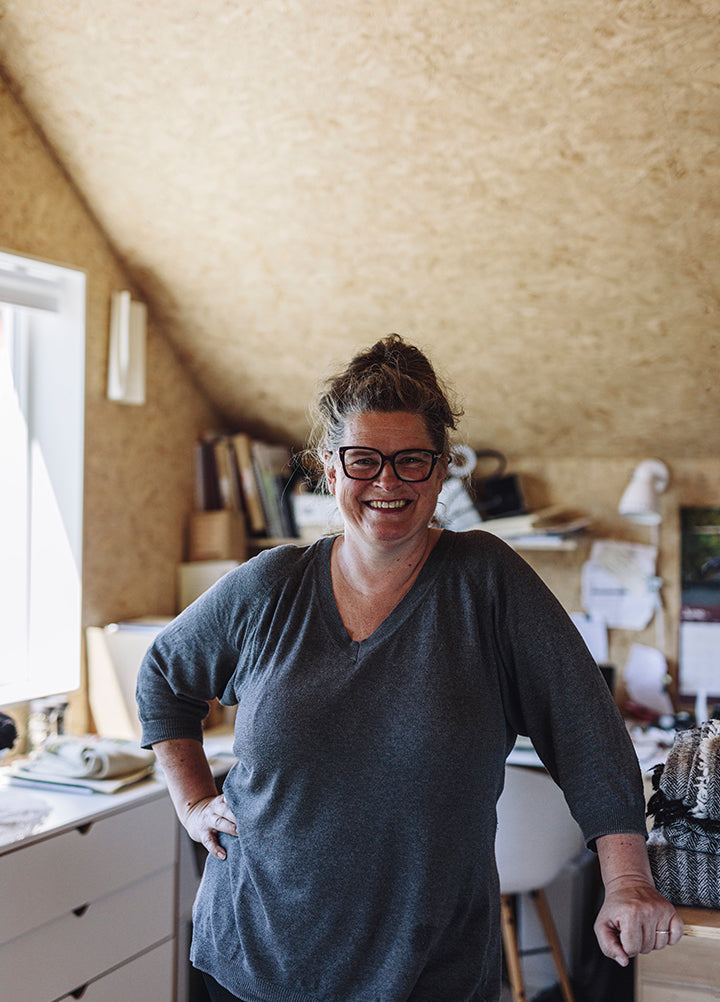
When textile craftswoman Ragnhild Lie learned that Norway’s home-grown wool is largely exported abroad, whilst local knitters were sat at home working with imported yarn, she decided it was time to take action. Time to take back the wool and the cultural heritage of the craft around it.
Using her extensive knowledge and experience of working with wool Lie decided to build an audience-oriented workshop around native breed sheep, wool and craft, based at her small farm in the Lofoten archipelago. In 2013 the first Old Norse Sheep arrived at the farm, and the following year Lofoten Wool was launched.
Since the beginning sustainability has been at the heart of everything we do. Our focus on local production, traditional craft skills and high-quality products has won us recognition both at home and abroad. Everything we do is rooted in the mindset that quality should endure over time, and that a sustainable, low impact approach is the best way to achieve this.
The craft
Without the wool, people would never have been able to settle in the North. People have learned countless techniques in joining fibers and threads into textiles, and today knitting has rightly become popular once again. With a few pins, a yarn you can create beautiful, practical garments that provide breathable warmth and comfort.
When woven, wool becomes even more versatile, producing cloth weights suitable for clothing, upholstery and interiors.


At Lofoten Wool we believe in small scale, localized production. Our yarns celebrate the abundance of natural raw materials available locally, and we carefully design our products to nurture and support traditional craft skills through local community production.
We continue to raise native breed sheep, which play a valuable role in maintaining a healthy landscape through traditional grazing methods that promote biodiversity. Our herd of Old Norse sheep are a hardy breed, typical of the area and have been a natural part of Norwegian fauna for hundreds of years. Saved from the brink of extinction, these animals have wool that is extremely robust and durable. In addition to our own sheeps wool, we source wool from a number of local farms that share our sustainability principles.
In keeping with tradition, our mission is to use as much of the sheep as possible. Besides from the wool, yarn and skin, we make soap from the fat. The close co-operation of our local slaughterhouse, Horn's, is invaluable in making this possible. All of the meat goes to the restaurant FANGST at Hattvika Lodge in Ballstad where they make fantastic dishes.
The yarn
Our Norwegian White sheep collection consists of both natural and plant dyed yarns from Norwegian White sheep raised in Røst, Vestvågøy and Flakstadøy. The wool from these sheep are soft fine fibers which gives a range of possibilities both for knitting and woven garments. We use the white crossbred wool but we also include the wool from the so called black sheep. The mix of these gives us a range of grey to black/brown tones.
Our other yarn collection is made from the more robust yarns which result from the native breeds; our own Old Norse sheep and Spæl sheep farmed at Flakstad and Vestvågøy, and from other farmers in the region.
Our natural sheep colored yarns are vintage yarns; that is, each annual batch is marked with the year the wool was sheared.


Plant dyeing
We plant dye the yarn at our workshop, achieving quality assured colors that date back to the Viking Age. In August, we and our friends pick the tansy flower and use this to create different shades of yellow. For red, we use madder root, whilst blue hues are developed by dipping the yarn into indigo baths.
Each color batch has its own unique shade resulting from the natural variations within nature and our part within the dying process. When we colour blends of white and gray yarn we get many options for color combinations.


The production
Designed in-house, our Lofoten Wool knitting patterns are often suited to both genders and offer a timeless look that can be achieved without advanced skills. Most of our garments and products are knitted by local hands - we work with many knitters across the archipelago!
In recent years, we have also started a small production of 3D knitted sweaters and small knitwear that are produced in Sykkylven, and finished by us in Lofoten.
The woven products we refine in the workshop with cutting, fringing and finishing. All work is done for the love of the craft.
Processing of the yarn begins at our own sorting station, where we sort the wool by colour and quality, before it’s sent by the coastal express down to Hillesvåg Wool Mill in Nordhordaland to be washed and spun into beautiful yarn. In recent years, we have also received help from Spinnerigården in Grimstad to make yarn from wool we collect from Norwegian White Sheep and Spælsauer in Lofoten.
Some of the yarn is sent to Krivi-Vev at Tingvoll, where our fabrics are woven to be used for a range of applications. We divide the fabrics and finish them in the workshop and make blankets, shawls, scarves, but also use them for furniture fabric, interior design and clothing.